|
|
|
PRESS PROFILE IN THE NEW YORK TIMES BY VIVEN SCHWEITZER: "Scoring the Music of Machines" THE SECRET LIFE OF PLANETS:Heavenly Bodies and Earthly Gossip is a song cycle that was premiered by the LA Phil at Walt Disney Concert Hall in 2022. Included in the "Best of 2022" in the L.A. Times, who wrote "The most imaginative new piece came later when the L.A. Phil New Music Group premiered Annie Gosfield’s The Secret Life of Planets. This is a riotous 37-minute song cycle that takes off from where the score for her opera War of the Worlds left off... The score is as fabulous as it is true to Gosfield’s planetary premise. The performance, conducted by David Bloom also proved fabulous." Read the whole review by Mark Swed WAR OF THE WORLDS, a wild new
opera directed by Yuval Sharon, was comissioned by the Los Angeles Philharmonic, and premiered in November 2017 at Walt Disney Concert Hall and on the streets of L.A. "Ms. Gosfield, whose imaginative works reflect her experience in the classical, rock and jazz worlds and blend acoustic and electronic elements to alluring effect... The music’s mood reflected the nature of radio jamming — abrasive, otherworldly and, at times, unexpectedly and eerily beautiful." "New York's doyenne of gnarly sampled sounds" "A ceaselessly re-inventive composer, Gosfield mixes history, technology, and autobiography in work that oscillates vibrantly between past and future." "An emotional highlight was Annie Gosfield's 'Long Waves and Random Pulses' for violin and jammed radio signals... The sound palette created by these multiple layers was astonishingly rich, and at times the virtuosic violin line above the repetitive radio signal patterns took on the tried-and-tested beauty of a Vivaldi concerto." "Few composers have come so close,
I think, to the true essence of industrial action–while the
environment is one of heat, grime, and sparks flying, the working
of the engine is precise and relentless" "The most kaleidoscopic and sophisticated
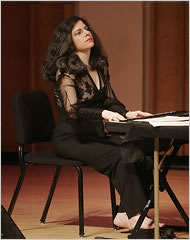
keyboard–sampler performance I've ever heard" –Kyle Gann, The Village Voice CD release concert review by Steve Smith: Music in Review: Annie Gosfield at The Kitchen By Zachary Woolfe Making Music Out of Uncracked Codes and a Factory’s Din by Allan Kozinn Click here to watch (and read) an interview in New Music Box Click here to read an unedited interview from The Wire Out of Static and Bleeps Can Come, Yes, Melodies: Concert review by Allan Kozinn in The New York Times, May 5, 2007, photo by Erin Baiano
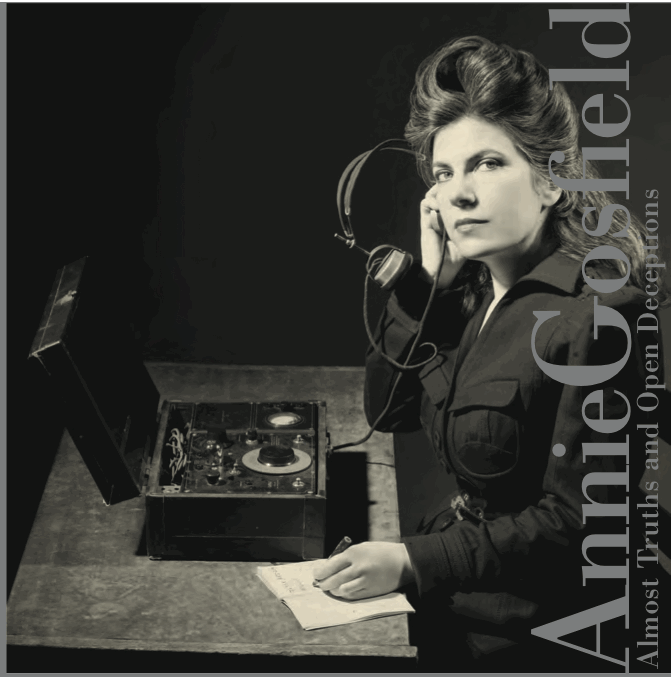
Annie Gosfield writes music that ranges from improvisatory and serendipitous to carefully notated. But running through much of her work is a fascination with noise. Her pieces are often about the ways that noise can be manipulated and put to musical use. Sometimes they are about the reverse: the way purely musical sounds can be made into noise, and then turned to expressive use. Ms. Gosfield offered an overview of her work in an installment of Merkin Concert Hall’s “Zoom: Composers Close Up” series on Thursday evening. The first half was devoted mainly to acoustic chamber works, the exception being “Lost Signals and Drifting Satellites” (2003) for electric violin and recordings of satellite transmissions. The transmissions are largely static and bleeping, but Ms. Gosfield is a close listener, and the melodies she hears within this space noise have become the seeds of a lyrical violin line, complete with arching themes and graceful trills. George Kentros gave the work a shapely, persuasive performance and was also heard as a member of the Pearls Before Swine Experience, the Swedish chamber group for which Ms. Gosfield wrote “Cranks and Cactus Needles” (2000). The title refers to parts of an antique record player, and the work, scored for flute, violin, cello and piano, is a modernist’s fantasy of an old 78-r.p.m. disc — one etched with chunky, acerbic, rhythmically complex music — grinding along. Here Ms. Gosfield uses noise descriptively: sections of dry sawing in the violin and cello lines are meant to evoke the distortions of the worn old disc. The concert began with a solo piano work, “The Wanton Brutality of a Tender Touch” (2006), inspired by a brawl at a baseball game, and given a forceful, virtuosic reading by Blair McMillen. Mr. McMillen’s sharp-edged, cluster-driven pianism was also a driving force in “Almost-Truths and Open Deceptions” (2007), a fresh, vigorous chamber work for strings, percussion and piano in which shifting (and sometimes pounding) rhythms and intricate interplay create the feeling of a rock-influenced dance suite. After the intermission, Ms. Gosfield and her rock trio played “EWA7” (1999), a work based on visits to factories in Nuremberg, Germany. Ms Gosfield’s sampling keyboard was loaded with industrial noise — machinery, buzz saws and industrial atmosphere, at various pitches — from which she wove an inventive, surprisingly musical line into a texture dominated by Ches Smith’s muscular percussion and filled out with patches of distorted color from Roger Kleier’s electric guitar. Review of "Lost Signals and Drifting Satellites" in The Wire: "Tzadik is becoming very good at single CD snapshots of modern composers, working across a multitude of idioms. More budget-minded classical labels will restrict a CD to a session with a single orchestra, or a solo piano recital, but the four pieces on Lost Signals and Drifting Satellites are scored for string quartet, violin and shortwave recordings, prepared piano, and solo cello. It's Annie Gosfield's third CD for Zorn's label and her music is unlike anything in the current European chamber spectrum, coupling zest and imaginative poetics with a warming textural glow underlying the spikiness. In The Harmony of the Body-Machine, Joan Jeanrenaud works the cello to a backdrop of rumbling metallic plates, crushing piledriver blows and rattling components. The piece was written during a residence in a German factory and is resonant with the intrusive noise of heavy industry, much like Gosfield's more pyrotechnic compositions on 2001's Flying Sparks and Heavy Machinery. The former Kronos member picks her way through the production lines with assured dignity, tripping lightly on harmonic skates and stroking hard and loud where necessary. Gosfield's own rendition of her prepared piano piece Mentryville is played with more vamp in her stride than you tend to find in Cage's definitive pieces for the distorted piano, a skeletal bar-room tinkle. The Flux Quartet swoon through the shifting gravities and vertigo-depictions of Lightheaded and Heavyhearted with aplomb. The title piece is played by its commissioner, Swedish violinist George Kentros, who requested a piece for "violin and something". The something he got was a delicate impasto of deep space satellite transmissions and shortwave broadcast static. The violin twirls gracefully through this galactic fog, a cosmic dance whose contours ripple around the amorphous motifs that occasionally surface in the electric shower. As I write, the Huygens probe is gearing up to plunge into Titan's gaseous shell, and this what I'll be listening to as it bumps into that bad boy." –Rob Young, The Wire, February 2005 |
||||||||||||||||||
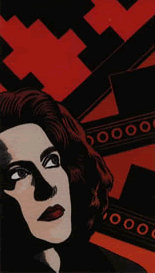
| Illustration from The New Yorker by Michael Kupperman |
 |
||||||||||||||||||
"Dealing musically with machinery is nothing new, but Gosfield's approach sets her apart. Working in what is usually considered a boys-with-toys aesthetic, Gosfield avoids the urge to charge into bloody, ear-splitting battle against the harsh reality of 21st century noise and decay. Instead, she listens for its beauty. Within the language of machinery she has discovered not precision, but rather imperfect rhythms and slippery pitches; her music transports the sounds of a factory floor or a crumbling player piano into the concert hall. Although Gosfield's work is frequently colored by mechanical sounds, her sonic memories can find expression as readily in the toe-tapping energy of an acoustic string quartet as in a work for prepared piano." – Molly Sheridan, Time Out New York, December 9, 2004 |
|||||||||||||||||||
|
Reviews of Flying Sparks and Heavy Machinery (Tzadik 7069) "Annie Gosfield is associated with the downtown New York scene, increasingly polymorphous in its involvement with improvisation, technology, popular and world musics, and experimentalism. Gosfield has tended to straddle the fence between strictly notated scores and improvised pieces, the fact that she directs her own performance ensemble giving her this flexibility. She has carved out a particular profile with her technique of combining samples of unusual sound sources with live instruments. The Manufacture of Tangled Ivory, written for the Bang On A Can All Stars and released on Sony, using in particular the sampled sound of a detuned piano, was my first encounter with her music, and I found it a knockout. EWA7 (1999) explores similar terrain, albeit on a much grander scale. It resulted from a residency at an industrial site in Nuremberg, Germany (the work's title is the name of the factory where the composer worked), sponsored by the Siemens corporation (to explore "connections between art and industry"; how enlightened!). A substantial portion of the work consists of industrial sounds Gosfield "collected": they are either performed from her sampling keyboard, on actual factory materials by two of the percussionists, or on an additional pre–recorded accompaniment. In addition, all the other musical ideas of the piece are inspired by sounds in the factory environment, and are played out in rhythmic patterns, repetitive motives, or the evolution of the live electronics part realized by Ikue Mori. All the musicians in the ensemble deserve some credit as co–creators, it appears, as many of their own musical responses to the factory sounds became part of the piece under Gosfield's editorship. Needless to say, this is all really "cutting–edge." And it is really good. Gosfield has a talent for recognizing sounds with genuine "presence", and then finding a musical context for their unfolding. As a result, repeatedly the work builds up a powerful momentum that allows us to accept its substantial timespan (about forty–five minutes, in three movements). At first the piece seemed somewhat episodic to me, but repeated visits suggest that there is a larger architecture at work. The first movement sounds expository in the way its elements are introduced and develop. The second has the quality of a scherzo, in that its materials are far more pulsed and "dancy", but still fragmented. The third allows a strong, seductive groove to take over, bringing the emergence of clear–cut rhythm to reach its orgiastic culmination. It's perhaps unfair to critique Flying Sparks and Heavy Machinery (2000) after EWA7. It's a perfectly well–wrought piece for string quartet and percussion using musical materials similar to its immediate predecessor. Heard in a different context, either live concert or on a different collection, I know it would impress me as the work of a composer with a distinctive voice. It's just that EWA7 is so sonically compelling, indeed overwhelming in its sheer sonorous force, that the other work on this program pales a bit in comparison. In the end, I find this a wonderful disc,
beautifully performed and produced. Perhaps more than any other
composer of her generation (the 40–somethings), Gosfield has
taken up the challenge of Edgard VarËse, writing music which addresses
forthrightly the aesthetic challenge of mechanization, technology,
and science. Her instincts for the use of "concrete" materials
are superb. She makes "noise" sound as though it was always
meant for the musical context in which she inserts it. She uses
the most contemporary musical technology to accomplish this task.
And often, the result fun to dance to! A winner."
"She invokes in vibrant, you–are–there
fashion the metallic pings, pangs, and clangs of a mass of machines
at midnight, but she doesn't just leave it at that. Gosfield
puts these sounds into a context, one that is episodic, insistently
rhythmic, almost cinematic. One can almost 'see' the wheels
turning, gears meshing and the glow of a combustion chamber as an
indistinct mass of metal slowly but certainly takes on shape and
purpose. As in nature, out of unrest, patterns emerge, followed
by an unsentimental, coarse beauty. This might be the music of a
factory, albeit one with heart."
Reviews of Burnt Ivory and Loose Wires (Tzadik 7040) "Only two or three people use the sampler
distinctively enough to be instantly recognizable, and Gosfield
may be chief in that respect. Her jumpy ostinatos and rhythmic intercutting
bring no one more recent than that crazy modernist George Antheil
to mind, while her brash sampled piano tones, precisely mistuned
to sound like the very image of desuetude, are wholly original.
Three of the six pieces here combine her raucous noises with various
Downtown–regular soloists. An other makes hay from sampled
acoustic synthesizer blips and bleeps, which must be a first, and
the last is a taut essay for the ROVA Sax Quartet that devolves
from microtonal almost–unisons into increasing improvisation.
An impressive debut disc."
"Annie Gosfield is one of the most interesting composers to emerge recently on New York's Downtown scene. Her music has the rough–timbred, rock–influenced, quasi–improvisato feel that is the trademark of much new work being created in that milieu, but she also has put a distinctive twist into her work that makes it stand out. By sampling an out–of–tune piano and then composing with the resultant library of sounds, she has created a characteristic tone color that suggest a crazy, breakneck musical machine, lurching, almost careening out of control. Yet at the same time, since all these sounds are quite specifically positioned on a digital keyboard, her control over this seemingly chaotic soundworld is in fact very precise. Few composers have come so close, I think, to the true essence of industrial action–while the environment is one of heat, grime, and sparks flying, the working of the engine is precise and relentless. I first encountered Gosfield's music on a Sony Disc (SK 62254) which I reviewed in Fanfare 20:1. The work then was The Manufacture of Tangled Ivory, which is included on this collection. I was blown away by the Partchian sound and energy of the work, a reaction sustained when I later heard it performed live by its dedicatees, The Bang On A Can All–Stars, at their festival's annual "Marathon" concert. While this work still stands out as the most masterful of all those on this Tzadik release, the other pieces are nonetheless quite strong and memorable. Nickolaievski Soldat has an astonishing break where a flood of percussive sounds tumbles forth like an overstuffed bag of bones from an opened closet; Four Roses creates a raucous and sinister dialog between scordatura cello and sampler keyboard; and Blue Serge performs the admirable trick of resurrecting (via sampling) wonderful 1960s–70s analog synthesizer sounds, and then performing them from the keyboard in a manner that would have been impossible with the architecture of the original technology. The largest work on the collection is Brawl, written for the Rova Saxophone Quartet (Bruce Ackley, Steve Adams, Larry Ochs, and John Raskin). It is appropriately gritty, and incorporates a range of structures, both fixed and improvisatory, to create a progression from wailing drones to ever greater complexity, as simple motivic ideas gain rhythmic profile and spin off into contrapuntal autonomy in each voice. Rova, for whom this sort of aesthetic–technical stance is second nature, plays with enormous brio. The performances sound authoritative, the
composer is a convincing performer of her own work, and the sound
is suitably clear and in–your–face. Despite its somewhat
punk sound, this is very serious and imaginative music, and bespeaks
a fresh voice on the experimental end of things to keep an eye on.
Recommended."
Live Reviews and Previews of EWA7 "Annie Gosfield, Phil Kline,
and Glenn Branca all unearthed new works. It was also one of those
nights in which you realized that Downtown American music–neglected
and despised yet bursting with idealism, inventiveness, and a willingness
to try anything–is truly with idealism, inventiveness, and
a willingness to try anything&is truly one of the world's great
musical traditions." "We get a new work by Gosfield,
whose whose explosions of factory sounds have to be heard to be
believed...All electric, all noisy, but all symphonic and done by
three of downtown's suavest musical thinkers." "The keyboardist–composer
can always be counted on to create a sense of spatio–temporal
dislocation–which certainly promises to be one component of
this program. She'll present EWA7, a machine–shop
throwdown that could reduce angst–ridden 'industrial'
poseurs to sobbing heaps." "An intense experience of rhythm,
sound color, and emotion."
Other Reviews "...On the great side, what first
comes to mind is Annie Gosfield's "The Manufacture
of Tangled Ivory". This two–part work begins
with a cadenza for solo sampler that undoubtedly sets the benchmark
against which future instrumental gestures will be measured. I first
heard the piece over my car radio before I knew what it was; I was
immediately trying to guess what composer had combined elements
of early Cage, Harry Partch, and Conlon Nancarrow into this technohybrid.
(And where did she get certain keyboard samples that include pops
and scratches? It shouldn't work, but it does.) The second
movement is a furious explosion, a thundering wall of pulsating
machine sound that is irresistible (and danceable). I heard the
piece in this May's Marathon, and came to the concert prepared
to be disappointed–any piece with this brilliant a sonic surface
had to be studio–specific, and would fall flat once it was
in a live context. Not true; it was even more exciting and corporeal
in live performance." "The old American West has never
seemed the most obvious setting for Haydn, Mozart, and Verdi. But
if those composers sounded particularly out of place here last week,
it was for reasons musical rather than historical. Old–fashioned
melody and harmony were out. Color, texture, and sheer sonority
were in. Living composers Kaiha Saariaho, a Finn, and Annie Gosfield,
an American, were the toasts of the town." "Gosfield writes with style and
assurance; chamber music represents roughly half of the composer's
output. The motivic workings in her string quartet stretched from
Eastern Europe to East L.A. The 18–minute, one–movement
study in extremes was at times a labor of cool, detached abstraction.
While almost constrained in sections, the Miami String Quartet had
lots of expressionistic flurries to play with. Theirs was an intensely
committed performance of Gosfield, unplugged. By contrast, The
Manufacture of Tangled Ivory, which closed the evening,
gave full vent to the composer's penchant for rhythm–driven
music. The work of detuned piano sounds had the feel of a cult–classic–in–the–making"
|
|||||||||||||||||||
| |
|||||||||||||||||||